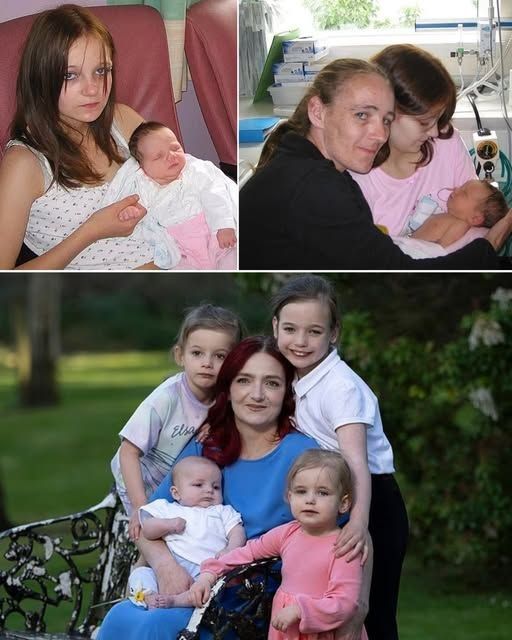
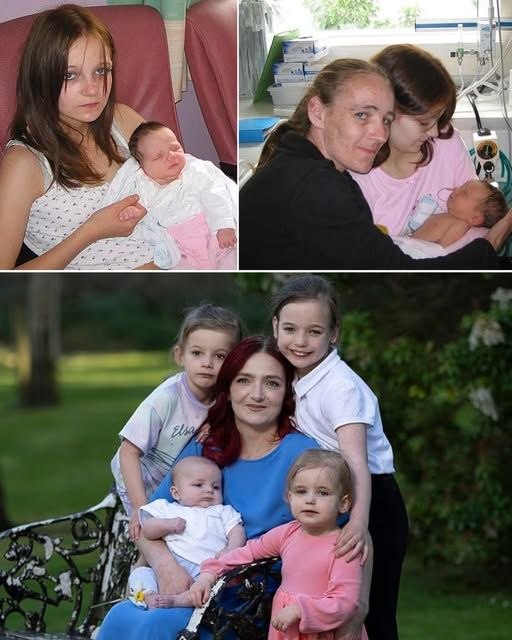
At 32, Tressa Middleton is still a young woman but she doesn’t feel it. ‘I feel old beyond my years,’ she says. ‘I feel like an old lady.’
Obviously, she’s exhausted, in the way that any woman with four children under nine would be.
The baby in her arms is just three months old. His sisters are eight, four and two.
She chats away about the difficulties of juggling sleepless nights, swimming lessons and the construction of plastic slides for the garden. Normal motherhood stuff? Yes and no.

Because Tressa Middleton is no normal mother. This time 20 years ago, she was about to make history by becoming the youngest mother in Britain.
Pregnant at 11, she gave birth in June 2006, aged just 12.
Her story – and the shocking images that accompanied it, with swollen belly, then a babe-in-arms – would end up on the front page of newspapers, inspiring polemics about the state of Britain.
That child, whom we shall call Annie, was taken into care (as was Tressa, for a while) and eventually adopted.


It’s still heartbreaking that it was Tressa’s late mother – in possession of only some of the facts – who sold the story to the Press.
Tressa had been drunk at a party, that story went, and ended up becoming pregnant. She also ended up – completely unfairly – becoming the poster girl for all that was wrong with our country.
It wasn’t until 2010, when I interviewed her for the Daily Mail, that the even more terrible truth became public.
I will never forget her breaking down and crying as the facts came out. Tressa had actually been abused by her big brother Jason from the age of around seven. The baby was his. He had been jailed for four years in 2009.
Why had Tressa not shouted this from the rooftops? For the same reason that many victims of familial abuse keep quiet. Family loyalties. The fear of rocking the boat. Just fear, full stop.
Tressa, to her credit, went on to attempt to reclaim her own narrative. Her memoir Tressa: The 12 Year-Old Mum was published in 2015.
It’s still a harrowing read, a devastating account of a childhood characterised by not only abuse but drug and alcohol addiction. The sort of childhood from which it is near impossible to build a happy and successful life.
For a while, Tressa did seem completely lost. In her teens and early twenties she went on to spiral into the same drug addiction that had blighted her parents’ lives.
She – and by then her partner Darren Young, whom she had just started seeing when we did that interview in 2010 – were injecting heroin and shoplifting to feed their addiction.
‘I’m surprised we’re not dead,’ she admits today. ‘And I’d actually rather die than go back to that life.’
How is she still here? The answer is to be found in Tressa’s children.
She introduces them proudly. The girls look just like their mum. Arihanna is eight, Harlow is four, Freya, two. Her son Keiren, born in January, completes the family.
‘We came off the drugs completely when I discovered I was pregnant with Arihanna in 2016,’ she explains.
‘I only ever wanted to be a mum,’ she says. ‘And I wasn’t going to give [Social Services] any excuse to take another baby from me.’
As much as they have made her life, there will be no more children. ‘I asked to be sterilised after Keiren,’ she says. ‘Don’t get me wrong. I love my kids, but I couldn’t cope with any more.’
Perhaps her body couldn’t cope either. There have been lasting physical consequences from a pregnancy so young.

‘Because I had Annie when I was so small, my ribcage was pushed out and it’s stayed like that. I’m sort of deformed.’
Mentally, how has she coped? It must be terrifying to be the mother of girls, the eldest of whom is approaching the age Tressa was when she became pregnant.
She nods. ‘By the time I was Arihanna’s age the abuse had already started,’ she tells me.
‘Not just with Jason, but even before him, there were two men on our street who’d get the floats ready for gala day. We’d go on the floats, all the kids, and they’d basically do stuff to us. It was grooming. Jason wasn’t the first to abuse or hurt me.
‘It’s one of my biggest fears, now that Arihanna is that age, especially because she has no sense of danger.
I’m thinking of getting one of those [tracker] tags to put in her shoe. But I’m telling you I’ll go to prison for murder if anyone hurts my girls in the way I was hurt.’
She has a son now, too. You don’t even have to say the unsayable here. She shakes her head.
‘What happened to me and my brother will never happen in
my family. The thought’s always there but it’s the one thing that I’ll make sure never ever happens. That’s my job.’
Where to begin with Tressa’s story? You really do have to go back to the very start.
She and her siblings grew up in extreme poverty in Scotland, and with extreme violence as their ‘norm’.
She can recall her father, Gary, beating her mother, Tracey. She can’t remember the first time she saw her mother drunk or doing drugs, because ‘it was always there. I do remember the smell of the drugs, everyone sitting around doing them’.
The family were well known to social workers, who were always around ‘with their fixed smiles and clipboards’.
 Pictured: Tressa Middleton 33 with kids Arihana 8, Harlow 4, Freya 2 and Kieran 3 months
Tressa and her siblings were in and out of care. She says she still jokes with her younger sister Dionne about the time they were in the same foster home. Dionne was a baby, still having bottles; Tressa would have been three.
Unable to get the attention of the grown-ups, but also too small to reach the bathroom sink, Tressa filled the bottle up from the toilet. ‘We still laugh about that,’ she says.
At four or five, she was returned to her mum; but by seven she was back in care. Then she was returned again.
The family lived at various addresses around Edinburgh and West Lothian; at one point there was a stint in a homeless unit, which she mostly remembers because her mum, ‘who tried her best’, double-locked the door to keep them safe from the unsavoury types who’d loiter on the stairs.
And yet, even at this stage, the bigger threat came from within. Tressa’s big brother Jason, five years her senior, had already started to abuse her – telling her that there would be trouble if she told anyone.
What’s so chilling is how much this incestuous rape was wrapped up with everyday life. On one occasion she recalls him forcing himself on her. Afterwards, The X Factor was on the TV, and they had fish fingers for dinner.
She was still only 11 when – suddenly unable to stomach the smell of vinegar – she suspected she was pregnant. Her periods had barely started. She confided in a friend first, then an auntie. Her mother’s reaction was to chase after her.
In her book, she recalled her mum saying: ‘You’d better run, you wee bitch. I’m going to kill you.’
Her mother was under the impression that another Jason – a young lad Tressa had been hanging around drinking with – was the father. Tressa knew he was not, but dared not say.
It was always going to be a scandal, with social services involved, but when a neighbour contacted the newspapers, Tressa’s pregnancy became global news.
And yet while all round her – particularly her mother and brother – urged her to have an abortion, she refused. ‘I always wanted her,’ she tells me. ‘Even with the way it happened, I always loved her. And she was mine.’ After a 16-hour labour, in June 2006, baby Annie arrived, weighing 6lbs 14oz.
It says so much that Tressa has kept some of Annie’s early clothes and books. They are carefully stored in a box. ‘I loved her from the moment I saw her,’ she says. ‘She was perfect.’
With only Tressa (and her brother Jason) knowing the truth about Annie’s paternity, life proceeded. For two years, Tressa and her baby lived in a children’s home, with a foster carer charged with looking after both mother and baby.
That was a precarious time, though. Although Tressa felt she was managing, in reality, she was failing to cope. She was going out drinking, getting into trouble. In 2009, however, her brother made another sexual advance – and it tipped her over the edge.
Distraught, she told a support worker that Jason was actually the father of her child. Then all hell erupted. Not only did the police – and ultimately courts – get involved after DNA tests proved that Tressa was telling the truth, but there was an awful showdown with her mother, who vowed to support both Tressa and Jason.

She confided in a friend first, then an auntie. Her mother’s reaction was to chase after her
The upshot? It was decided that it was not in Annie’s interests to stay in Tressa’s care, even with support of social services. Reluctantly, she signed the adoption papers.
When I spoke to Tressa in 2010, this was a matter of great injustice to her. She felt her child had been ripped from her.
She was legally entitled to only limited information about what had happened to Annie, and she wanted more. Today, now that little girl is an adult, it’s still heartbreaking, but Tressa’s reaction is much more mature.
‘I still love her. I still think about her all the time. Ari knows all about her, and I’ve still got all her clothes and things. But she’s had a good life, and that’s all that I could ask for. She’s got her mum and dad, and grandparents and she doesn’t think of me as her mother.
‘But to me she’ll always be my baby, my Annie.’
The miracle is that Tressa wasn’t entirely destroyed after that, although she came close.
She tells me that the years immediately afterwards were a haze as she descended into exactly the sort of life her mother had lived.
Meeting Darren Young only gave her a partner in crime.
‘It was wild with the drugs, and shoplifting. We were doing an eighth [of a gram of heroin] at a time, then robbing to pay for it. A guy would sell the stuff we shoplifted on eBay. It was almost like a job to us. We’d be rattling from the withdrawal every night, then get another hit.’
They did attempt to get off the drugs, going on a methadone replacement programme.
‘For a while we were Giro Junkies. We’d only do it when we got our Giro payments.’
Getting pregnant with Arihanna changed everything, she says.
‘Darren and I both knew that you couldn’t have a child and still be on the drugs. It just can’t be done.’
She insists she hasn’t been a saint since. ‘Don’t get me wrong. There’s been the odd spliff,’ she says. But she says she has been clean of hard drugs for her children’s entire lives.
‘I was terrified at first. When I was pregnant with Ari they [social workers] came to the house. We’d bought a Moses basket, boxes of nappies, all that, but I was scared they’d say we hadn’t done enough.’
She went on to have two more daughters, thinking ‘that was it’. Baby Keiren was a surprise, but a happy one. ‘I thought I was having another girl,’ she says. There were complications with this pregnancy, which resulted in her being prescribed codeine, then morphine.
‘I said to the doctors, “I can’t have anything that is opiate-based. I just can’t go back there.” I ended up flushing the morphine down the toilet because I was starting to feel the withdrawals again.’ The medication was changed.
It’s always hard to tell how much the state safety net works in these situations. With Tressa’s children, help seems to have been there – and taken when offered.
‘I always had this vision of social workers being the bad guys, but if you work with them, they don’t want to take your kids away. They just want to make sure everyone is safe. I didn’t get that when I was a kid. I get it now.’
Isn’t there an argument that social services should have taken her and her siblings into care permanently, and earlier?
‘Sometimes I wish we’d all got taken into care. I wonder what life would have been like if we’d grown up in a normal family.
‘But I love my mum. I’ve always loved my mum. But we didn’t have a chance in hell.’
Tressa also cites a drug support worker as being particularly helpful. Without her, she says, we probably wouldn’t be having this conversation today.
She’s not doing that job any more. She’s a beautician now, but I see her from time to time,’ she says. ‘I want to train to be a drug worker myself.’
It’s odd to speak to a 32-year-old who is only now wondering about what career she could have. Tressa is clearly a bright and articulate woman, but her education was a disaster.
She says that she still couldn’t read by the age of 15. ‘I kind of taught myself, but I still can’t spell now.’ ‘I’ve done it all the wrong way round,’ she concedes.
‘At the age my girls are, I should have been out playing with a bat and a ball or dollies. I was out drinking and smoking.’
There is still something of the little girl about Tressa. Neither of her parents are still around. Her mum died in 2012, aged just 41, from pneumonia. Jason was still in prison at the time, but was released for the funeral. Tressa remembers little about that. ‘I was on the drugs, so it was all numbed.’
No such protection when her father died in 2024. This time, she went to pieces. ‘He’d been an addict. He’d been abused. He had a tough life, but I loved him. When he died, the rug was just pulled from under me.’
She remembers falling to her knees in the hospital, being told he was gone. And there, to offer a hug, was her brother Jason.
It was the first time she had seen him since her mum’s funeral. She does not want him in her life ‘to the point that my kids don’t even know that I have an older brother’, but at that moment, she needed him. She acknowledges the awfulness of this.
‘I remember being on the floor, then him just holding me as my heart broke. I’ll always appreciate that he was there, that somebody was there. I don’t want him in my life.
‘I can’t have him in my life, but his childhood was messed up, too.’ This is a terrible family history for these children to learn about, one day, which they will.
Tressa says it will be up to her to present the story in a way they will understand.
Suffice to say, she wants better for her kids than she ever had growing up. Her dreams for them are achingly modest.
‘I tell Arihanna – she’s old enough to understand – that she needs to grow up and have a good life. College, maybe university. Get driving, be able to afford holidays. I say, “Don’t have the life I’ve had.” ’
